Author Archives: Joyce Huddleston

February 2020 meeting: Commonwealth War Graves Commission

On 10 February, Dick Richards described the history and achievements of the Commonwealth War Graves Commission. It was founded, as the Imperial War Graves Commission, through the vision and determination of one man, Sir Fabian Ware. Working for the Red Cross, he arranged the recording of soldiers’ graves during the First World War. In 1917 the Imperial War Conference accepted his proposals for a permanent Commission.

Guided by distinguished professionals, including architect Edwin Lutyens, garden designer Gertrude Jekyll, and poet Rudyard Kipling, the Commission established its core principles:

  • burial close to the place of death
  • equality irrespective of rank or religion
  • uniform headstones
  • memorials giving the names of those with no grave
  • headstones, graves and memorials to be maintained in perpetuity.

Every CWGC cemetery aims to evoke the grass, flowers and peace of an enclosed country churchyard. The headstones are in straight lines in a standard size and format. Bereaved relatives could, initially for a fee of threepence halfpenny per letter, choose a short personal inscription. There is a Christian ‘cross of sacrifice’, a Stone of Remembrance to acknowledge those of other faiths or none, and a shelter containing a cabinet with a list of the graves and a visitors book.

The Commission is also responsible for individual graves in many parish graveyards (including Radley), and for memorials to those with no known grave, most notably the Ypres (Menin Gate) Memorial.

The Commission undertakes to maintain every cemetery in perpetuity, including, for example, the one in Hong Kong now surrounded by modern development, and, when it becomes possible, the restoration of its cemeteries in Iraq.

On Tuesday 19 May, at 6.30 pm, Dick Richards will give RHC members a guided tour of the CWGC cemetery at Botley. This includes the graves of soldiers who died in military hospitals in Oxford, many Polish and German soldiers, and, poignantly, the graves of two women: staff nurse Mabel Murray and aircraftwoman Glenys Harris.

On Monday 9 March Nick Millea will talk about the forthcoming Atlas of Historic Maps of Oxford.
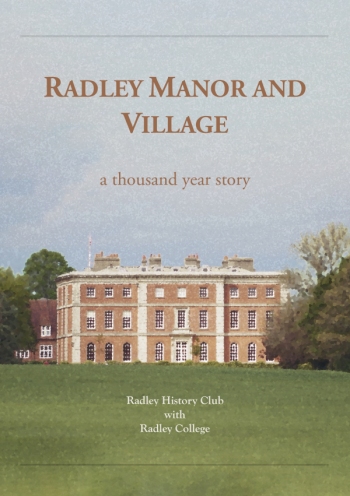
Buy a copy of the Club’s latest book

RADLEY MANOR AND VILLAGE a thousand year story was published on 30 November 2019. Copies can be bought via the Club’s website or in person from Radley Village Shop. The book costs £15 (plus postage & packaging).

The book was researched and written as a collaboration between Radley History Club and Radley College’s archivist. It tells the history of Radley’s manor and its relationship with the village from around the time of the Norman Conquest to the present day. It explores the changing role of the manor, the people who held it, how they lived and the power they exercised, as well as how the lives of ordinary villagers were affected by the manor.
More details

Front cover of 'Radley Manor and Village: a thousand year story'
Front cover of ‘Radley Manor and Village: a thousand year story’

January 2020 meeting: Post-war childhood in a resettlement camp

On 13 January, a large audience braved the rain to hear Dr Hubert Zawadzki explain the history of the reluctant exiles in Polish resettlement camps in Oxfordshire and the Cotswolds, 1946 to 1970.

During World War II the government-in-exile of occupied Poland was based in London, and many Poles fought alongside the Allies. Following the Yalta conference in February 1945, the frontiers of Poland were drastically redrawn, and the Soviet Union installed a puppet communist government. Many Polish servicemen decided not to return.

From 1946, they could join the Polish Resettlement Corps, a unit of the British Army set up to help them prepare for civilian life in Britain. They, and if possible their families, were housed in former military camps, ill-adapted to the harsh winter of 1946-7.

From 1947 support was provided under the Polish Resettlement Act, including dedicated schooling for children, and training of adults for civilian jobs.

Hubert’s family were housed in a Nissen hut in Springhill Lodges camp (near Chipping Campden), with a coke stove and no running water. There was a communal kitchen, providing, for example, a soggy mash of cornflakes in hot milk. Initially there were misunderstandings: Hubert was nearly refused entry to the local primary school because he didn’t know the word ‘horse’ in English, and his mother initially took ‘public house’ to mean dom publiczny (i.e. brothel). Gradually matters improved: the camps became thriving communities with their own churches and festivals. A group photo survives of Hubert (in an unconventional white suit) on the occasion of his first communion. Most ex-servicemen became happily integrated into life in Britain, for example as doctors, or skilled labourers in post-war reconstruction, and gradually families moved out of the camps into their own housing.

Traces or ruins remain of many of the camps, including Springhill and, in Oxfordshire, Checkendon. There are commemorative plaques at Northwick Park (now a business centre) and Fairford. There is an excellent website with a list of all the camps, and many stories and photographs: polishresettlementcampsintheuk.co.uk

On 10 February Dick Richards will talk about the work of the Commonwealth War Graves Commission.

Launch of Club’s latest book

Radley Manor and Village: a thousand year story

When: Saturday 30th November 11am to 4pm
Where: The Mansion, Radley College, Kennington Road, Radley, Abingdon OX14 2HR

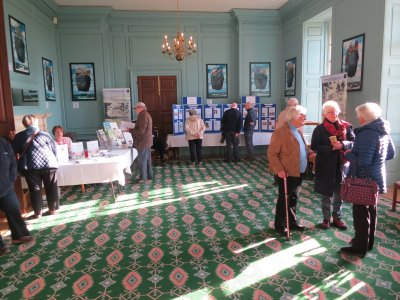
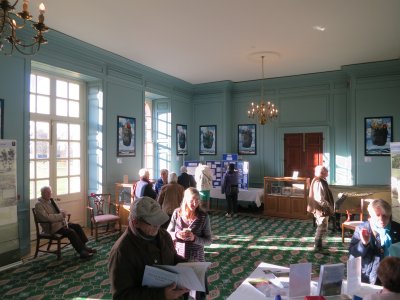
A bright, sunny day and the historic Mansion at Radley College provided the ideal setting for the launch of Radley Manor and Village: a thousand year story. The Mansion was built by the Stonhouse family in the 1720s as their manor house.

Launch of 'Radley Manor and Village: a thousand year story' at The Mansion, Radley College, on 30 November 2019

Radley Women’s Institute served hot drinks and delicious cakes in the entrance hall. Displays included a timeline of 1000 years of national and local events, family trees of the Stonhouse and Bowyer families, photos and facts about Radley servants, and banners depicting the College grounds and their links with ‘Capability’ Brown. Also on display were artefacts belonging to Radley College, such as a laundry maid’s goffering kit from the mid-1800s, used to put fine pleats into the shirts of Radley ‘dons’.

Another photo from the launch

The book is a collaboration between Radley History Club and Radley College’s archivist. It uses first-hand and contemporary sources, and tells the story of Radley’s manor and its relationship with the village from around the time of the Norman Conquest to the present day. Employment, land ownership, and deference are recurring themes.

The final chapter includes episodes from the lives of Radley village couple David and Beryl Buckle and their relationships with Radley college. The book was partly funded by a legacy from David Buckle to Radley History Club, and so the Club was particularly pleased that his son Peter at the launch.

More about the book and how to buy a copy


November 2019 meeting: Radley Large Wood

On 11 November, Richard Dudding unveiled many surprises in the history of Radley Large Wood: monks, deer, riots, a projected canal and a ‘mist of bluebells’.

The wood was Abingdon Abbey’s deer park, supplying the monks with venison, other game, timber, and fuel. It has the characteristic rounded shape of a woodland deer park, and traces remain of the ditches cleverly designed to make it easy for deer to jump in, but not get out again. In about 1260 the Abbey appointed ‘John Parcarious and his heirs’ as park keepers. But the Abbot seemed to fear that the Parker family would turn poachers. Two keys were simultaneously required to open the wood’s main gate: one held by the keeper, and one for the Abbey’s bailiff to check what the keeper was bringing out.

Around 1350, members of the Parker family were named as ringleaders of riots in Abingdon, and depredations in the deer park. The Abbey tightened the Parkers’ contract, requiring the keepers to swear an oath of loyalty to the Abbot. In 1387 the Abbey won a court case against King Richard II, who had claimed that he had the right to appoint the park keeper.

Following the dissolution of the monasteries, the Abbey’s estates were sold. In 1547, a survey included the ‘separate wood’ then known as ‘Radley Parke’, including 200-year old oaks and an underwood of ash and willow saplings, coppiced every 7 to 10 years.

In 1560, George Stonhouse bought Radley Manor. The Stonhouse family kept the Large Wood for timber and game, and made a separate ornamental deer park near the manor house. From 1671, the Game Laws entrenched hunting as a privilege of the gentry, and there were severe fines for poaching.

In 1795, Radley Manor passed to the Bowyer family, who were a bankruptcy waiting to happen. One of their disastrous ventures was a project for a canal from Bayworth quarry, taking a huge loop southwards into what is now north Abingdon, continuing northwards to Radley Large Wood, and then descending to the Thames at Sandford. The wide ditch still visible at the western edge of the wood could be the result of excavations for this canal.

In 1883 the third Sir George Bowyer died, the creditors pounced, and the estate was again for sale. In 1900 Josephine Dockar-Drysdale purchased it. In the economic depression of 1930, her son William could not find a buyer for the estate, including the wood, which was advertised as a ‘mist of bluebells’ which could make an ‘admirable timbered building estate’. In 1938 her grandson Bill set up a holiday camp for boys in the wood, later becoming a home for wartime evacuees. In the 1950s he opened a new camp, this time for family holidays. Pat Groser came from London to stay, and liked it so much that she moved in as secretary. Supporters of Halifax rugby league team made it a regular stopover on their journeys to the league final at Wembley.

The wood now includes three sylvan mobile home parks. The Parish Council’s adopted neighbourhood plan notes that the Council would oppose their conversion to other uses. The wood is classified as ‘ancient semi-natural woodland’, and hugely appreciated by local walkers. Sadly, its tranquillity might be threatened by one possible route of the proposed ‘expressway’. The church’s heating worked perfectly, and a large audience overflowed into the gallery. You can read more about the wood and Radley Manor in the History Club’s book, Radley Manor and Village, on sale in the village shop or from the Club’s website.