| DATE | SPEAKER | TITLE OF TALK |
|---|---|---|
| 2026 | ||
| 12 October | Joseph Rogers | Tithe Barns (including local barns) |
| 9 November | Mike White | Rogues of the Road: Tales of Oxfordshire Highwaymen |
| 2027 | ||
| 11 January | Martin Buckland | Malting and Brewing in Abingdon |
| 8 February | Liz Woolley | Dream Palaces: A history of the Ultimate Picture Palace and early cinema in Oxford |
| 8 March | Andrew Long | The Naming of Oxfordshire Pubs |
| 12 April | Roger Thomas | The Archaeology of Abingdon |
| 10 May | Jan Marshall | A Tale of Twin Cities |
| 14 June | Stephen Wass | The Peculiar History of Fishponds and Fishing in Oxfordshire and Around: an archaeological perspective |
| 12 July | Gillian Cane | The Miracle of Bletchley Park |
| August | NO MEETING | |
| 13 September | Richard Dudding | Radley History Club Archive |
Category Archives: Club news
New postcards now on sale
Over 500 Radley History Club postcards have sold since they went on sale in 2015. With very few left, the Club decided to produce two new designs to sit alongside the two most popular of the original designs – the Millennium Map and the group of four of Radley’s historic buildings.
The postcards cost 80 pence each from Radley Village Shop where they on sale alongside fresh stock of the Millennium Map and ‘buildings’ postcards, and residual stock of the postcards of the church in autumn and the pond. All the postcards are 6 x 4 inches in size.
One of the new postcards features colour photographs taken this year following completion of the restoration work on the exterior and interior of Radley Church. The other is a black & white archive photograph of Radley Station in 1919 – when it had staff, a signal box and other buildings, and a third platform serving the branch line to Abingdon (referred to locally as the ‘Bunk’).
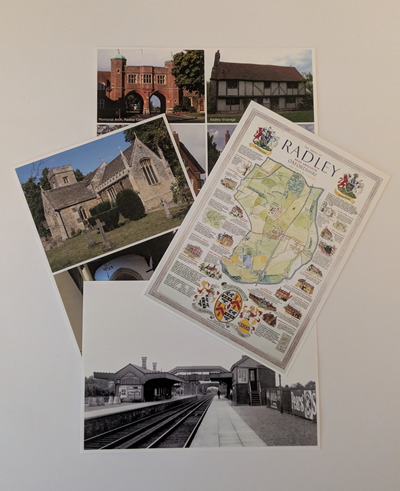
To order one or more postcards please contact the Publications Manager.
May 2022 meeting: Members’ evening
The evening provided a chance for members to give a short talk about a person, place, item, event or topic they’d researched.
By careful examination of census returns, street directories, electoral registers and old maps, Joyce Huddleston has traced successive locations of Radley (sub) Post Office. In the second half of the 19th century, it was in a now demolished cottage on the corner of White’s Lane and Church Road; a VR postbox survives, opposite the church. By 1901, the Post Office had moved to what is now Baker’s Close, Lower Radley, where there was a thriving bakery and shop. By 1921, Alice Machin was the sub-postmistress at Walnut Cottage, Lower Radley. The last location, from the early 1920s until closure in 2013, was 23 Church Road (formerly 4 Council Houses). You can see the VR postbox on the Radley Heritage Walk.
Charlie Milward reported a tale of hope and tragedy. In the 1870s, agricultural workers in England suffered poverty and deprivation. Many emigrated, in the hope of a better life. In 1874, 17 members of the Hedges and Townsend families from Shipton-under-Wychwood embarked on the Cospatrick to sail to New Zealand. The ship caught fire 700 miles from the Cape of Good Hope and all the emigrants died. There is a memorial to them on Shipton village green.
By complete coincidence, Harriet Moggridge related a happier emigration story. Harriet’s mother Cass has published a book on the successful maiden voyage of the Charlotte Jane, 1848-1850, carrying emigrants and cargo to Australia, returning via China. Captain Alexander Lawrence (Harriet’s great great grandfather) was accompanied on the voyage by his young wife Miriam and their baby daughter. The book draws on a memoir written by Miriam and the ship’s log book. It recounts losing and replacing a mast, storms, rows among the emigrants, and arriving in the ‘incomparably beautiful’ Sydney harbour.
Using material from the Club archives, Joyce Huddleston related how Radley celebrated the Coronation in 1953. There was a procession up to Radley College, a dinner for older residents, street parties and a quarter peal of bells.
Richard Dudding described the Club’s extensive archives, which include wills, photographs, maps, journals, sound recordings – and a cricket scorebook. You can find the archive catalogue, and details of how to contact the archivist, on the Club’s website.
To round off the evening, members toasted the 25th anniversary of the Club’s first meeting.
April 2022 meeting: The first Oxford v Cambridge boat races
On 11 April, Mark Davies related the early days of the Oxford and Cambridge (men’s) boat races. The idea came to two school friends, Charles Wordsworth (Christ Church, Oxford), and Charles Merivale (Cambridge). In March 1829 Cambridge University Boat Club issued a challenge to the University of Oxford ‘to row a match at or near London, each in an eight-oared boat, during the ensuing Easter vacation’.
Stephen Davies, boatbuilder at Oxford, was requested to post this challenge ‘in some conspicuous part of his barge’. Davies acted as coach to Oxford college crews, and became known as ‘Professor of Rowing’.
The first race took place at Henley, actually in June 1829; watched by large crowds. Oxford won. The rowers from Oxford wore dark blue, the Christ Church colours; the Cambridge crew was in pink or scarlet. In 1836, after protracted arguments about the course, Cambridge won the second race, from Westminster to Putney. This time the Cambridge boat was adorned with a light blue ribbon.
In 1843, again in Henley, Oxford won, though rowing with only 7 men. Their boat was displayed opposite Grandpont House, near Folly Bridge, where it became rotten and decayed. In 1867 Thomas Randall, a tailor who lived at Grandpont House, purchased it and had it incorporated into the President’s chair inside the university barge.
From 1845 the course was between Putney and Mortlake.
March 2022 meeting: Club news and Poor Law in crisis
At our meeting on 14 March, members recorded their thanks to Charlie Milward for his stalwart service as Treasurer since 2015, and to Colin Orr Burns for agreeing to take over the task.
Colin reminded members of the importance of oral history. Collecting it requires care and skill: from personal experience of mis-remembering when he had heard a particular song, Colin could attest that memories can be unreliable. The Club’s Oral History Group’s current interviews are focusing on Radley residents’ memories of life during the Covid-19 pandemic.
Deborah Hayter then spoke about Poor Law in the 18th century. Poor Law had been codified by the Act for the Relief of the Poor, 1601. This empowered voluntary church officials in each parish to collect rates for the relief of the parish’s sick, elderly, orphaned, ‘unable’, or ‘impotent’ poor. A few parishes set up workhouses, providing ‘indoor relief’. More commonly, the poor received ‘outdoor relief’ of food and clothing. The officials ‘moved on’ vagabonds.
In the 18th century the cost of poor relief hugely increased, in some places beyond ratepayers’ ability to pay. There was growing disquiet about the ‘undeserving’ poor. In 1771 Arthur Young, agricultural reformer, wrote that ‘Everyone but an idiot knows that the lower classes must be kept poor or they will never be industrious.’
In 1795 the magistrates in Speenhamland (near Newbury) devised a scale for linking benefits to the price of bread. This was widely copied, but growing disquiet about its cost led to the Poor Law Amendment Act of 1834, which instituted nation-wide, and deliberately prison-like, workhouses.