New book: The Radley Lakes Story

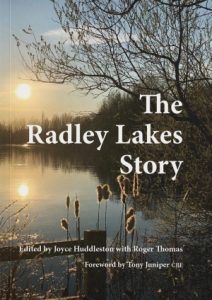
The Radley Lakes Trust is pleased to announce the release of The Radley Lakes Story, a beautifully crafted book that tells the captivating story of Radley Lakes’ remarkable journey from threatened gravel pits to a cherished natural haven. This commemorative publication marks 20 years since the Save Radley Lakes campaign began and showcases the enduring power of community action to protect and enhance our local environment. 

Edited by Joyce Huddleston and Roger Thomas, with contributions from leading local naturalists, historians and environmentalists, the book combines expert knowledge with over 250 stunning illustrations. It provides readers with an insight into the area’s geology, history and wildlife, and the community’s enduring commitment to its preservation.  More details

Front cover of 'The Radley Lakes Story', published in March 2025

The book costs £16.99 and is available to buy:

Proceeds will go directly to the Radley Lakes Trust to safeguard the future of Radley Lakes and its surrounding ecosystem. 

The book includes material from the Radley History Club archive. The Club’s archivist, Richard Dudding, was one of the contributors to the book while the Club’s chairman, Joyce Huddleston, led the editing team.

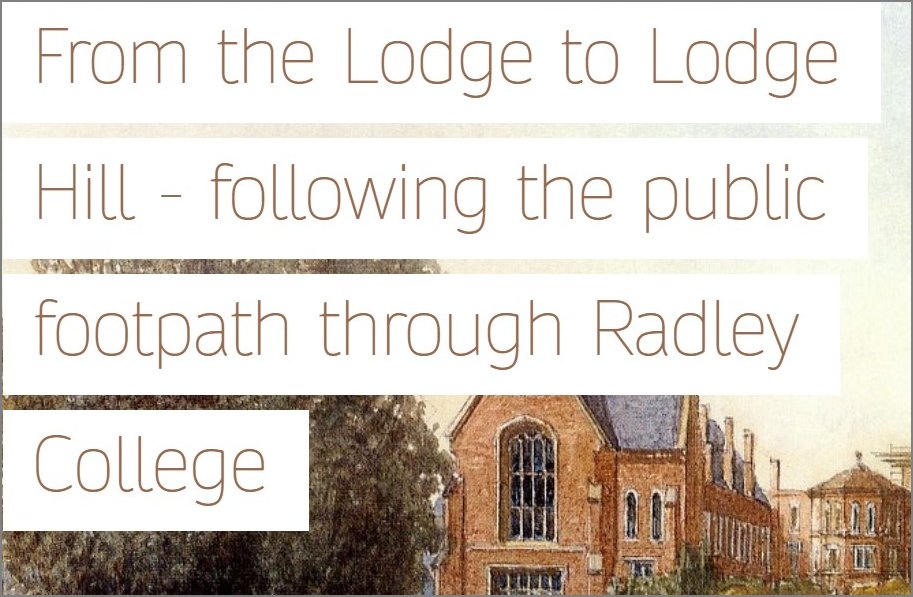
‘From the Lodge to Lodge Hill’: a guided walk through the grounds of Radley College

The story of the Radley College estate is told in a new guided walk devised by Clare Sargent, the Radley College Archivist. QR codes on posts at key places along the route take you to online information about particular points on the route. The walk goes from the Lodge (on Kennington Road) to Lodge Hill following the public footpath through the College grounds.

Here’s a link to a fascinating presentation hosted on Microsoft Sway of the material available via the QR codes. The presentation contains some wonderful archive photos and drawings with explanatory text and links to further information.

Screenshot of part of the entry point to the presentation on Microsoft Sway of 'From the Lodge to Lodge Hill - following the public footpath through Radl;ey College'

February 2025 meeting: A walk along the Thames Path from Oxford to Pangbourne

On 10th February, we welcomed Bill King – supported by his wife Flora – for a talk about the Oxford to Pangbourne section of the Thames Path. Over several years Bill and Flora walked some 150 miles of the Thames Path in stages from the river’s source in the Cotswolds to where the river becomes tidal at Teddington Lock in north-west London.

Bridges, locks and pubs are key elements of the walk and Bill showed photographs of many of them. Bill and Flora chose to begin their walk along the Oxford to Pangbourne stretch at King’s Lock north of Oxford, near to where Duke’s Cut connects the River Thames to the Oxford Canal. Their route took them through Oxford and then past Radley and Nuneham Courtenay to Abingdon, Culham, Sutton Courtenay, Clifton Hampden, Wittenham Clumps, Dorchester, Shillingford, Benson, Wallingford, Streatley and Goring, Whitchurch and into Pangbourne.

Between Oxford and Pangbourne the route of the Thames Path changes from one side of the river to the other a number of times. Apart from one short deviation, the Path runs alongside the riverbank all the way. Various signposts and waymarkers keep you posted on the direction and distance to key points on the route.

Bill and Flora took the opportunity to wander off the Path at different places to visit churchyards with the graves of famous people such as J.J.R. Tolkien, Kenneth Grahame, Eric Arthur Blair (aka George Orwell), Herbert Asquith and Lady Mallowan (aka Agatha Christie). They also spotted several Blue Plaques on the walls of buildings along the way.

Visit the National Trails website to learn more about the Thames Path.

January 2025 meeting: Radley – the thousand year evolution of a manor

On 13 January, a packed church enjoyed a talk from Richard Dudding, the Club’s archivist, on the story of the manor of Radley from before the Norman Conquest to today. Over time the ‘hard power’ of the manor declined, but ‘soft power’ and social status continued to matter. At several points, new entrants (and their money) brought new energy. Richard divided the story into five periods.

Abingdon Abbey about 1000–1538: Radley was part of the Abbey’s large manor of Barton. Its importance to the Abbey was its long river frontage, its eel fisheries and the Abbey’s deer park.

The Crown 1538–1560: After the dissolution of the Abbey, some interesting names held the manor: Henry VIII, Edward VI, Sir Thomas Seymour (brother of the Lord Protector) and Princess Elizabeth (from 1558 Queen).

Stonhouse family 1560–1795: The newly created manor of Radley was sold to George Stonhouse (famous in the village for being a Clerk of the Green Cloth). The Stonhouses held the manor for over 200 years. An 18th century Stonhouse built what is now ‘The Mansion’ at Radley College, surrounding it with gardens and parkland.

Bowyer family 1795–1889: With no male heir, the manor passed to a relative by marriage, Admiral Sir George Bowyer (feted as a naval hero). His son was hopeless with money and fled to Italy with his family in 1815. His son, a philanthropist, racked up huge debts leading to the estate’s sale in 1889.

From about 1850: Two newcomers to Radley filled the vacuum. Radley College was founded in 1847 and, in 1850, a Scottish businessman William Dockar bought Wick Farm. At the 1889 sale, his daughter Josephine Dockar Drysdale (builder of Wick Hall) snapped up the land (selling some to Radley College).

Front cover of 'Radley Manor and Village: a thousand year story'

The talk drew on research for the Club’s book, Radley Manor and Village. Copies are available, price £15, from Radley Village Shop or direct from Joyce Huddleston (publications@radleyhistoryclub.org.uk).

November 2024 meeting: WW2 rationing and cooking for victory – a fair share for all

On 11 November (Armistice Day) Karen and her husband Bret, 1940s historians and re-enactors, gave a spirited and comprehensive talk complete with audio recordings from the period. The talk began by explaining the context of rationing prior to World War II: Britain saw the first widespread implementation of rationing in WW1 after there was a shortage of wheat and other commodities in 1916 when ships carrying supplies were targeted by the Germans.

People were encouraged to use every available piece of spare land for food production under the banner of ‘Dig for Victory’, even the grounds of the Tower of London were dug up! Cooking programmes on the radio attracted enormous numbers of listeners and recipe leaflets were distributed to citizens. The Women’s Institute (WI) played its part in helping to preserve fruit and veg after being supplied with mobile canning machines; it is estimated WI members canned 5 million pounds of jam and 2 million pounds of preserves. The food rationing system ended in 1954, marking a significant milestone in Britain’s return to normality.

At the end of the talk, we were invited to try some recipes from the period (see the photo below). If you want to find out more about the recipes and other homefront activities you can visit Karen and Bret’s website, Doing Their Bit: Life on the Home Front.

Display of WW2 food packaging and other memorabilia, plus examples of foods produced from WW2 receipes